
WOSS
SODA Contexture: The Open Context Engine Supercharging AI Data Pipelines at Scale
Aman Mundra · May 4, 2026 · 8 min read
Contents
✍️ Co-Authors:
1. Ayushi
2. Aman
Table of Contents:
1) Introduction
2) What is SODA Contexture
3) Why Context Matters
4) Problems It Solves
5) System Architecture
6) Open Context Specification (OCS)
In the rush to deploy AI agents across massive data landscapes, one silent killer lurks: missing context. AI models drown in raw metrics, CPU spikes, query latencies, storage IOPs, without knowing what they mean, where they come from, or how they connect. There’s no coherent story behind the numbers, no clear relationships between the components, and no shared understanding of what “normal” even looks like. The result? Hallucinations, delays, skyrocketing costs, and unreliable insights that force teams into endless cycles of manual verification and incident firefighting.
Enter SODA Contexture, an open‑source powerhouse from the SODA Foundation, a sub‑project under the Linux Foundation. SODA Contexture builds enriched, structured contexts for AI agents, turning chaotic data into precise, actionable intelligence. Rather than treating every query as a fresh, high‑effort search, it layers context on top of your existing data infrastructure so AI can reason more like an experienced engineer than a guess‑based oracle. Drawing from the criticality of context in AI data pipelines, SODA Contexture isn’t just another tool, it’s the missing link that makes scalable, trustworthy AI possible in production environments.
What is SODA Contexture?
SODA Contexture is an open context‑building engine for AI. At its heart, it’s designed to solve a simple but profound problem: how do you tell an AI agent what matters about your data, and why it matters that way? Instead of dumping petabytes of raw telemetry into a model and hoping it “figures it out,” Contexture systematically enriches data with operational meaning, relationships, and constraints.
It does this using the Open Context Specification (OCS), a standardized blueprint for describing operational data in a way AI can actually reason over. OCS is not just a schema, it’s a shared language for how metrics, logs, events, and metadata live together in a system. This means that whether your AI agent is reasoning about database performance, Kubernetes pod health, or object storage throughput, it’s working from the same structured, consistent worldview.
Hosted under the SODA Foundation, SODA Contexture tackles the “context gap” head‑on. Instead of feeding AI raw data dumps and patching it with ad‑hoc prompts, Contexture generates tailored contexts using internal context agents and third‑party context sources. You can think of it as transforming a Prometheus metric like cpu_usage_ns_total{instance='node‑1'} into something like "CPU usage in nanoseconds for node‑1, which is part of the webapp pod group in namespace production, currently under a rolling deployment." It's the same metric, but now with topology, ownership, and operational rhythm attached.
Why now?
As AI pipelines scale to petabytes of data across clouds, Kubernetes clusters, and edge environments, generic prompts simply cannot keep up. An AI model asked to “analyze latency” has no idea whether it’s looking at frontend request latency, database query latency, or network hops between services, unless it’s given a clear, structured context. SODA Contexture steps in precisely here: by standardizing how context is defined, built, and consumed, it makes AI inferences reliable at enterprise levels.
This is especially important as organizations move from “proof‑of‑concept” AI projects to production‑scale monitoring, observability, and remediation. In that world, a wrong inference or a hallucinated root cause isn’t just inconvenient, it can trigger unnecessary rollbacks, noisy alerts, and even downtime. SODA Contexture reduces that risk by giving AI a stable, shared understanding of the system’s data landscape.
The Key Problems It Solves
AI struggles without context, and the symptoms are predictable:
- Results flip‑flop and vary wildly based on tiny differences in data quirks, formatting, or mixed knowledge sources. This makes AI seem inconsistent and untrustworthy.
- AI invents facts when relationships between metrics, entities, and services are unclear. This leads to hallucinations where the model “explains” something that never happened, simply because it couldn’t connect the dots.
- Querying massive datasets without guidance wastes cycles, as the model ends up scanning broad swaths of data instead of zooming in on the right subset.
- Endless iterations and manual verification become the norm, because every result needs to be treated as tentative until validated by a human.
- The system doesn’t scale well across multiple agents or data sources, since there’s no shared context layer to coordinate them.
SODA Contexture tackles all of these problems by anchoring AI in structured, shared context. OCS lets it define exact data fingerprints for each source, so the AI can distinguish similar metrics from different environments (e.g., staging vs. production). It encodes topology and relationships so AI understands how pods, volumes, databases, and services are connected. It defines semantics so the model knows what a number actually represents and avoids mixing apples and oranges. It adds temporal context so the agent knows whether it’s looking at a point‑in‑time snapshot or a trend. And it includes operational constraints like thresholds, polarity, and aggregation rules so the AI can reason about health and risk in a way that matches real‑world operations.
A real‑world analogy makes this vivid: imagine you’re debugging a microservices outage. You see a CPU spike, but without context, you don’t know whether it came from a specific pod, during a deployment, or during a traffic surge. AI, in that scenario, might blame the wrong service or suggest a mistaken fix. SODA Contexture, however, provides the full map: “this CPU spike is from pod X in namespace Y during a rolling deployment, and it’s statistically correlated with increased API error rates from service Z.” With that context, AI can move from guessing to reasoning.
System Architecture: How It Works
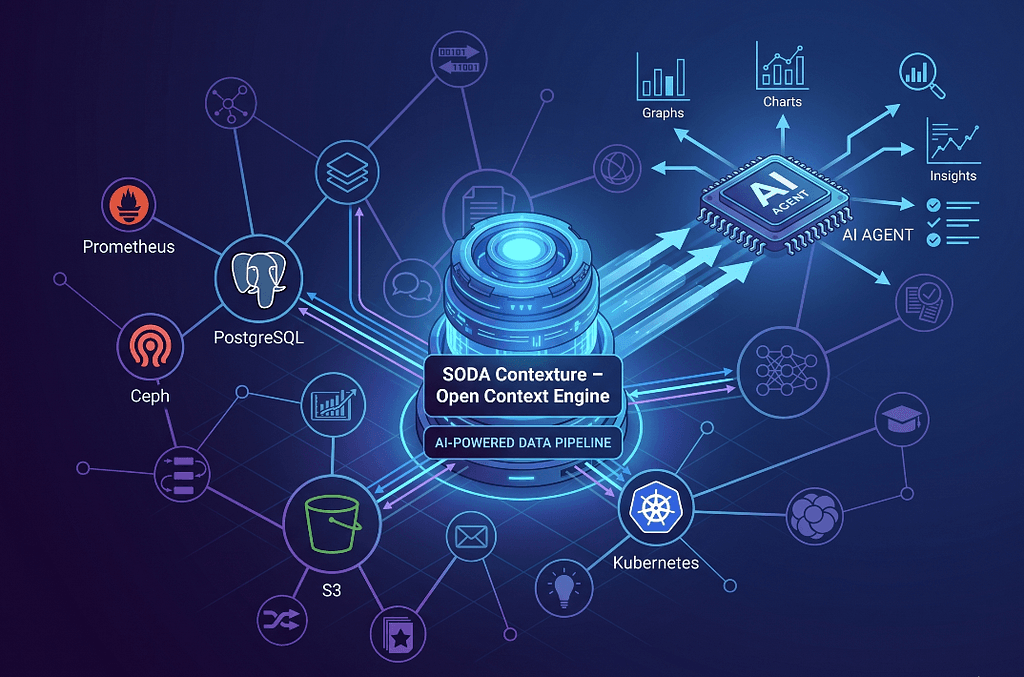
SODA Contexture’s architecture is built around one core idea: context should be an explicit, composable layer in the data pipeline, not an afterthought baked into prompts. At the center sits the SODA Contexture Engine, which orchestrates the entire process of context creation and delivery.
When a user or an AI agent issues a query - such as “Analyze storage anomalies” or “Explain the latency spike in the web tier” - the engine first parses the request and determines which data sources and relationships are relevant. Then it taps into data connectors that plug into stores like Prometheus, PostgreSQL, Ceph, Amazon S3, and others. These connectors don’t just fetch raw data - they understand the layout, schema, and semantics of each source so the engine knows how to interpret and enrich it.
Parallel to that, context providers - such as Kubernetes APIs, Istio, or other observability platforms - supply additional operational metadata. This might include deployment topology, service dependencies, ownership labels, or SLO definitions. The engine then combines raw data from connectors with metadata from context providers, and assembles the result into an OCS‑compliant context object. This object is then delivered to the AI agent, which can query or reason over it with much higher precision.
Conceptually, the data flow looks like this:
Query → Data Connectors → OCS Engine → Enriched Context → AI Agent
Within that flow, the SODA Contexture Engine handles orchestration, routing, and caching. Data Connectors act as adapters for specific data sources, abstracting away their idiosyncrasies. Context Providers act as external enrichers, adding operational context on top of the raw metrics and logs. The result is a modular, composable system that can scale horizontally to support many agents and many data sources at once.
Open Context Specification (OCS): The Secret Sauce
At the heart of SODA Contexture lies the Open Context Specification (OCS), a standardized schema for describing operational data context in a way that AI can reason over. OCS is not just a technical detail; it’s the standard that makes interoperability, consistency, and shared understanding possible across different teams and tools.
OCS structures context into several key dimensions:
- Identity and Origin (“Who” and “Where”) defines the unique fingerprint of a data source. It answers questions like: Which cluster, environment, team, or namespace does this metric belong to? AI needs this to distinguish between similar metrics from different environments and avoid confusing staging with production data.
- Dimensionality and Topology (“Relationships”) describes how a metric or entity relates to others. Is this CPU metric from a pod that belongs to a specific deployment? Is this disk throughput tied to a particular storage pool? These relationships are the most critical part for AI reasoning, because they allow the model to trace causal chains and infer dependencies.
- Metric Semantics (“What”) defines what the number actually represents. Is it a count, a rate, a latency, or an error percentage? This prevents AI from comparing unrelated metrics as if they were equivalent and helps it interpret the meaning of values correctly.
- Temporal Context (“When”) answers when the data was observed. Is it a point‑in‑time snapshot, a moving average, or a cumulative counter over a specific interval? This helps the AI handle time‑series reasoning properly and distinguish momentary spikes from sustained trends.
- Operational Constraints (“How”) defines how the metric should be interpreted in operational terms. What are the thresholds that indicate warning or critical states? What does “high” mean - good or bad? What aggregation rules apply? This lets AI reason about health and risk in a way that aligns with real‑world SLOs and operational policies.
Together, these attributes form a rich, machine‑readable context model that AI can use to make more accurate, consistent, and reliable inferences. Instead of treating every query as a blank slate, AI agents can reuse and build on the same shared context layer across many use cases - from incident analysis and anomaly detection to capacity planning and performance optimization.
In other words, SODA Contexture plus OCS don’t just make AI “smarter.” They make AI operational- embedded in the same structure, constraints, and semantics that real engineers and operators already live with every day.
Originally published on the Welzin Medium.