
Agentic AI
LangChain vs LangGraph vs LangSmith
Welzin Technology Blog · October 28, 2025
LangChain vs LangGraph vs LangSmith
✍️Co-authores
1. Krishna
2. Aman Mundra
Table of contents

1. Introduction
2. What is LangChain
3. What is LangGraph
4. What is LangSmith
5. Real-World Use Cases
6. Where Each Tools Fit Best
7. In-Depth Comparison
8. Key Takeaways
9. Conclusion
10. References
1. Introduction
Large Language Models(LLMs) are changing how we create AI-powered applications. However, the actual impact depends on the frameworks we use to manage and organize these models. The right tools can significantly affect how efficient, scalable, and easy to maintain your projects are.
Among the many frameworks available, LangChain, LangSmith and LangGraph have become three popular choices. Each one focuses on different part of the LLM development process. Understanding their strengths and limitations can help you choose the best one for your project.
As a student specializing in AI and someone who has worked with automation tools like n8n for Answer Engine Optimization and Generative Engine Optimization, I’ve explored these platforms firsthand. In this article, we’ll take a closer look at these frameworks. I’ll share my personal experiences to provide real insights from a builder’s perspective.
2. Understanding LangChain
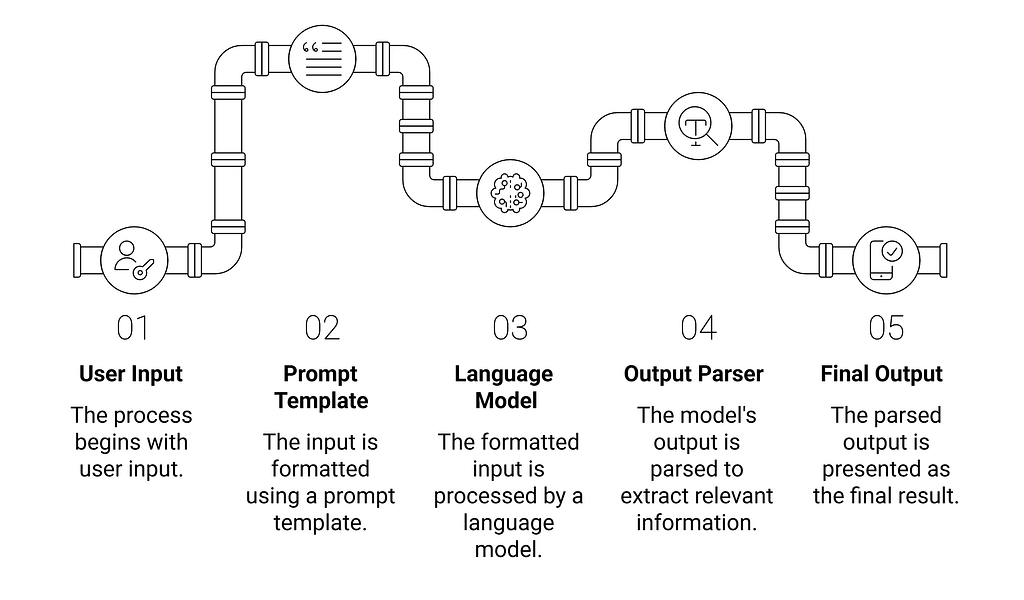
LangChain is a useful open-source tool that simplifies building applications with large language models (LLMs). It helps developers connect different parts of an AI system, such as prompts, memory, and external services, enabling them to create smarter and more interactive applications.
With LangChain, you can easily gather data from databases, APIs, or other tools to build full AI workflows. It’s effective for tasks like retrieval-augmented generation (RAG), question-answering systems, or chatbots, whether you are trying out ideas or developing production-ready solutions.
Here’s why developers appreciate LangChain:
- It connects well with many popular data sources and APIs.
- It includes built-in features to manage memory and context, making conversations or workflows feel natural and consistent.
- It offers strong documentation and an active community, which makes learning and finding support easier.
from langchain_openai import OpenAI
from langchain.prompts import PromptTemplate
from langchain.chains import LLMChain

# make sure you have your OPENAI_API_KEY set in environment
llm = OpenAI(model="gpt-3.5-turbo-instruct")

prompt = PromptTemplate.from_template("Translate {text} into French.")
chain = LLMChain(llm=llm, prompt=prompt)
result = chain.run({"text": "How are you?"})
print(result)
3. Understanding LangGraph
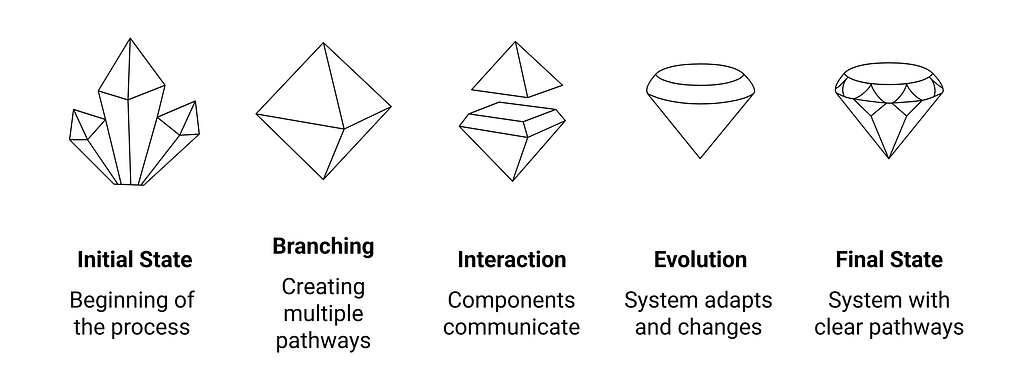
LangGraph offers a new, graph-based method for creating LLM workflows. Instead of working in a straight line, as traditional chains do, LangGraph lets you organize your logic in a network of nodes and edges. Each node represents a step in the reasoning process, and the edges illustrate how information flows between these steps.
This structure is particularly useful for applications that require dynamic decision-making or multi-step reasoning. Examples include advanced chatbots, multi-agent systems, and interactive dialogue flows with numerous potential paths.
Key benefits of LangGraph:
- It provides a visual and modular way to design workflows, making it simpler to understand and manage complex logic.
- It is flexible, enabling you to create non-linear interactions and easily add conditional branches.
- It integrates well with node-based tools like n8n, making it easy to connect with other automation systems.
from langgraph.graph import StateGraph, END


def step_one(state):
 return {"value": state["value"] + 1}


graph = StateGraph(dict)
graph.add_node("increment", step_one)


graph.set_entry_point("increment")
graph.set_finish_point("increment")

app = graph.compile()

result = app.invoke({"value": 1})

print(result) # Expected: {'value': 2}
4. Understanding Langsmith
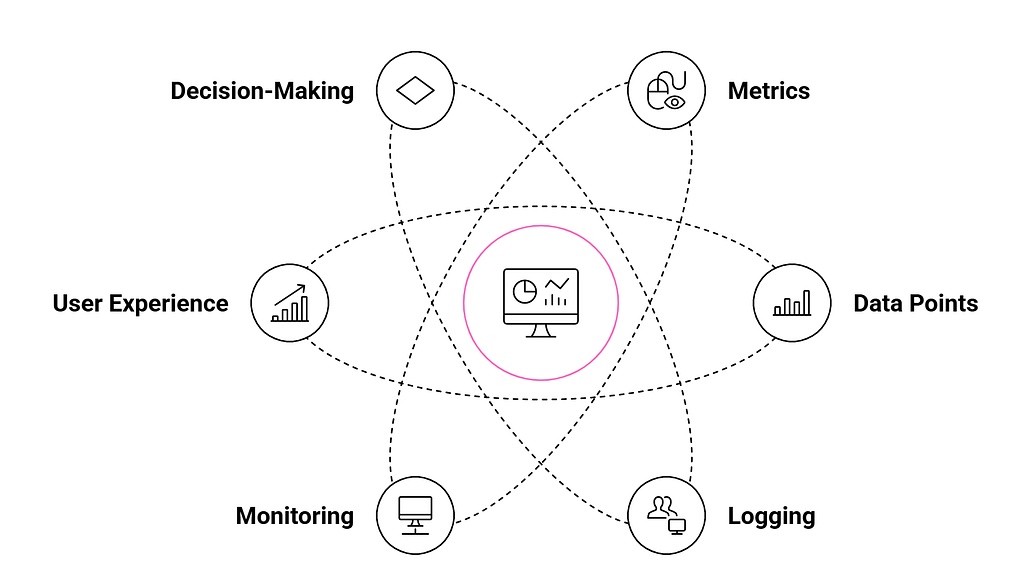
While LangChain helps you build LLM workflows, LangSmith focuses on monitoring and improving them. Think of LangSmith as a tool for diagnosing and analyzing your AI applications. It provides developers with the means to debug, evaluate, and optimize their workflows by showing how prompts perform, where delays occur, and how outputs change over time.
With LangSmith, developers get access to:
- Detailed logs for every step in an LLM workflow, making it easier to trace and fix issues.
- Evaluation metrics to measure how accurate and relevant the model’s responses are.
- A visual interface to compare different prompt versions and track improvements.
This makes LangSmith an excellent choice for teams that need to iterate quickly, maintain reliability, and scale their applications without losing performance. It’s not a replacement for LangChain; it complements it, forming a strong pair for building and refining production-ready AI systems.
from langsmith import Client

#make sure LANGCHAIN_API_KEY is set in your environment
client = Client()


run = client.create_run(
 name="test_run",
 inputs={"query": "Hello"},
 run_type="chain",
 project_name="default",
)

print(f"Run created with ID: {run.id}")
5. Real-World Use Cases
Who Uses Them
• Startups: Many AI-first startups use LangChain to quickly prototype and release features.
• Enterprises: Larger organizations incorporate LangSmith to ensure reliability and track performance as they grow.
• Researchers & Developers: LangGraph is often explored in labs or innovation teams working on multi-agent systems or adaptive reasoning.
Community and Growth
• LangChain has the largest and most active community, with extensive documentation, tutorials, and open-source contributions.
• LangSmith is newer but is steadily gaining traction among enterprise teams who need observability and reliability.
• LangGraph is the youngest of the three, but it’s attracting attention from developers already familiar with node-based or graph-style tools.
Industry Applications
• Customer Support: AI chatbots powered by LangChain workflows, optimized and monitored through LangSmith.
• Automation Platforms: LangGraph excels at agent-based automation that mirrors tools like n8n.
• Knowledge Management: LangChain and LangSmith are used to build internal knowledge assistants that remain reliable as they scale.
• AI Copilots: Developers explore LangGraph to create more adaptive copilots that can branch into different reasoning paths.
5. Where Each Tools Fit Best
Each of these frameworks has a specific role in the process of building with LLMs. Understanding their strengths will help you choose the right one for your needs:
· LangChain: Rapid Prototyping and Standard Workflows
LangChain is ideal for creating quick prototypes, retrieval-augmented generation (RAG) systems, or simple chatbots. Its collection of ready-made integrations allows you to connect prompts with memory, APIs, and databases without starting from scratch.
· LangGraph: Complex or Branching Logic
When an application needs multiple pathways, decision points, or interactions between agents, LangGraph’s graph-based structure provides the necessary flexibility. It works well for dynamic workflows, branching dialogue systems, or multi-agent reasoning, where linear chains can become hard to manage.
· LangSmith: Monitoring and Reliability
LangSmith emphasizes observability and optimization. It is especially useful when an application is functional and ready for testing or large-scale deployment. By offering logs, performance metrics, and evaluation tools, LangSmith helps ensure that LLM applications stay reliable and continue to improve over time.
In practice, these tools work together instead of competing. A common approach might be to use LangChain for building workflows, LangGraph for advanced reasoning structures, and LangSmith to evaluate, monitor, and improve performance in production.
6. In-Depth Comparision
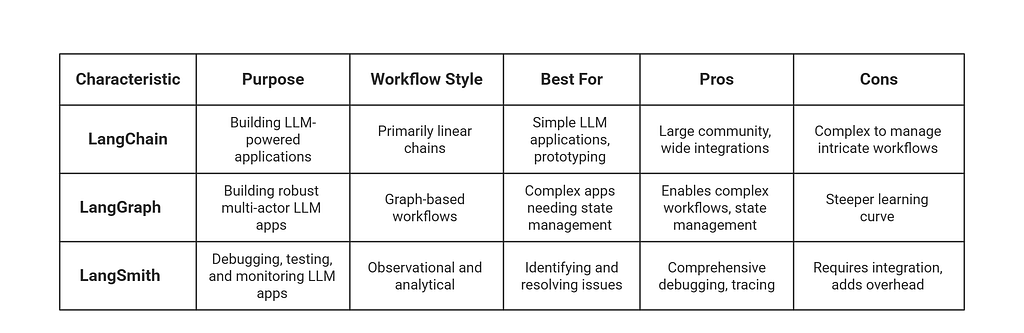
When comparing these three tools, it’s important to understand that they serve different purposes even though they operate in the same ecosystem.
Ease of Use and Learning Curve: LangChain offers the most beginner-friendly experience thanks to its extensive documentation and thriving community. LangSmith requires some familiarity with LLM operations but remains accessible. LangGraph, while extremely powerful, demands a bit more effort to design and maintain intricate graph structures.
Workflow Design: LangChain excels at linear or moderately complex pipelines. LangGraph shines when workflows involve branching logic or dynamic pathways. LangSmith doesn’t design workflows itself but integrates with the others to provide analytics and insights.
Debugging and Monitoring: LangSmith is unmatched in observability. Developers can track every step of their LLM interactions, compare prompt iterations, and identify performance bottlenecks. LangChain offers basic logging, while LangGraph benefits significantly when paired with LangSmith for monitoring.
Scalability and Flexibility: For large-scale deployments, combining LangChain with LangSmith provides a solid foundation for building and maintaining production systems. LangGraph offers unmatched flexibility for applications requiring adaptive or non-linear reasoning, though it may require more engineering effort.
7. Key Takeaways
• LangChain is best for rapidly prototyping and deploying LLM applications with a clear linear or slightly branching workflow.
• LangSmith is essential for teams who prioritize reliability, monitoring, and optimization.
• LangGraph is ideal for complex reasoning tasks where a graph-based structure allows for dynamic decision-making.
Rather than choosing one over the others, many developers find success by combining these tools. For example, you can use LangChain to build the core application logic, LangGraph to handle complex decision pathways, and LangSmith to monitor and optimize the entire system.
8. Conclusion
The rapid evolution of AI frameworks means developers have more tools than ever to build sophisticated LLM applications. LangChain, LangSmith, and LangGraph each bring unique capabilities to the table. LangChain simplifies construction, LangSmith ensures performance and reliability, and LangGraph enables advanced reasoning and branching workflows. By understanding their respective strengths and strategically integrating them, developers can unlock new possibilities in building intelligent, scalable, and maintainable AI solutions.
10. References
- https://docs.langchain.com/
- https://docs.langchain.com/langsmith/home
- https://www.langchain.com/langgraph
Originally published on the Welzin Medium.